
Standard numbers on a Chinese tag, and what each prefix commits the maker to
The standard line is the tag's citation. Its prefix says who wrote the yardstick, its year says which version, and three public registers let you open the document yourself.
Standard numbers and what their prefixes mean
China's measures for national standards, issued as regulator order No. 59 and in force since 1 March 2023, set the codes in article 32. A mandatory national standard is written GB, a recommended one GB/T, a guidance document GB/Z, and a national reference material GSB.
The same article fixes the shape of the number: the code, then the serial number the standard was issued under, then the year it was published. GB 18401-2010 is mandatory standard 18401 in the version of 2010. GB/T 22849-2024 is recommended standard 22849 in its 2024 version.
Two more prefixes are common on clothing: industry standards, which for textiles start with FZ/T, and company standards, which start with Q/. Between them, these codes say who wrote the yardstick the piece is held to.
One more national code turns up inside standards rather than on tags. GSB numbers mark national reference materials, such as the pilling photographs a laboratory compares fabric against; the T-shirt standard cites several of them.
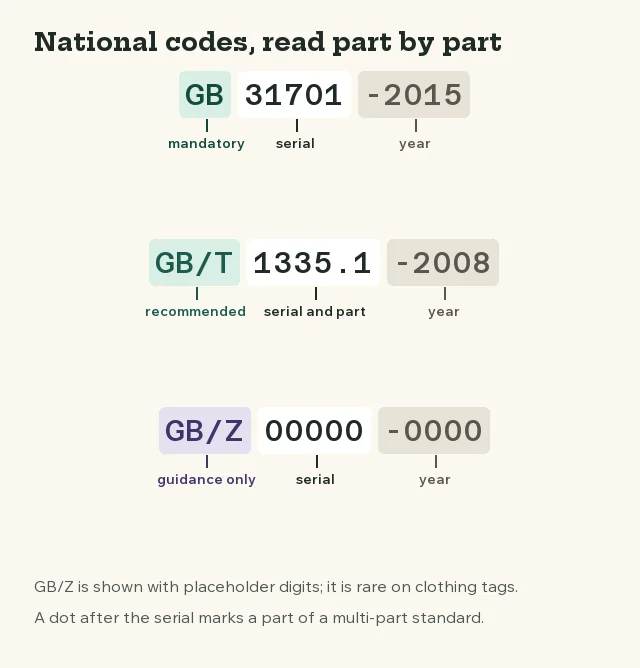
Mandatory and recommended, in the law's own words
The standardization law, revised in 2017, draws the line in article 2: national standards are either mandatory or recommended, and industry and local standards are recommended. Mandatory standards must be followed; the state encourages the use of recommended ones. Article 25 adds that products failing a mandatory standard may not be made, sold or imported.
Recommended does not stay optional once printed. The product quality law requires a product to conform to the standard marked on it. And article 27 of the standardization law asks every company to publish the numbers and names of the standards it follows, so the number on the tag should also be on public record.
Read a tag accordingly. GB 18401 is binding on every maker whatever is printed. A recommended number becomes binding on the maker who chose to print it.
Industry standards with an FZ/T prefix
Industry standards fill the space between national standards and a company's own. For textiles and clothing the code is FZ, and because the law makes every industry standard recommended, the form you meet is FZ/T. They are filed with the national industry standards service, a public lookup.
One example shows how a record reads. Its entry for FZ/T 73020-2019, knitted casual wear, gives the industry as textiles, the status as current, the in-force date as 1 July 2020, and the version it replaced as FZ/T 73020-2012. A tag that still cites the 2012 version is pointing at a withdrawn document.
Industry standards also appear inside national ones. The knitted T-shirt standard sends sizing to FZ/T 70014 or the national size standard, so the size line on a tee can trace back to either.
Company standards with a Q/ prefix
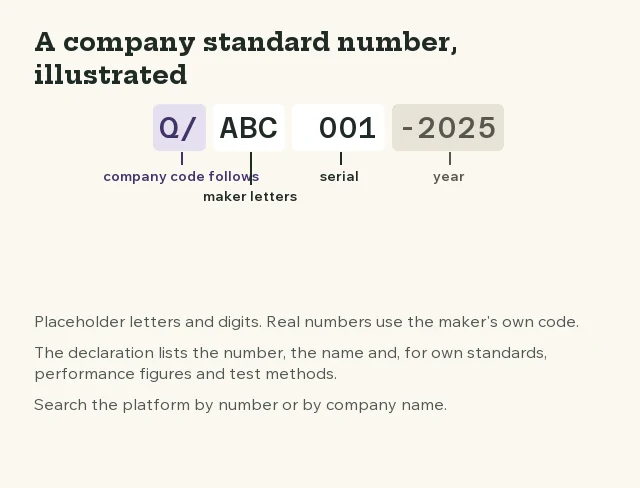
A maker may write its own standard, and many do for products no national standard quite fits. Article 13 of the measures on company standardization, regulator order No. 83 in force since 1 January 2024, fixes the number: Q, then a company code in letters or digits or both, then a serial number, then the year.
Article 14 is the part that helps a buyer. Companies must publish the numbers and names of the standards they follow, and a company following its own standard must also publish the product's performance figures and the test methods behind them. The national enterprise standards platform is where those declarations are posted.
So a Q/ line is not a dead end. It names a document the maker was meant to make public, and if the declaration is there, the grade or performance on the tag has figures you can read.
The year after the dash, and replaced versions
Standards are revised, and the year is how you tell versions apart. The safety code in force today is the 2010 version, which replaced one from 2003. The knitted T-shirt standard was reissued in 2024, replacing 2014. FZ/T 73020 moved from 2012 to 2019.
A standard number needs both its year and its scope. Check the issuing body’s record for the cited edition, any replacement and its implementation dates. An older printed year alone does not establish that an item is lawful, unlawful or covered by a newer edition; the product and relevant dates matter.
One case looks wrong and is not. The label-set standard was converted from mandatory to recommended on 23 March 2017, so its record now reads GB/T 5296.4-2012, while the page header of the document itself still prints GB 5296.4. Tags citing either form refer to the same text.
Looking a number up yourself
National standards issued before 2017 are all published in full, except recommended standards adopted from international ones, and newer ones follow within weeks of approval, on the national standards full-text system. Search by the serial number, open the record, and read three things: the status, the in-force date and any note.
That note is where surprises live. The record for the label-set standard carries the 2017 conversion to recommended. The full text opens in an online viewer, so a curious buyer can read exactly what a tag is promising without relying on anybody's summary, ours included.
Industry standards are on the industry standards service and company declarations on the enterprise standards platform. All three are free to search and work without an account.
Numbers you are likely to meet on clothing
A handful of numbers cover most clothing tags. The safety class line cites GB 18401 or, on children's pieces, GB 31701. The product standard line cites a garment standard such as GB/T 22849 for knitted tees or FZ/T 73020 for knitted casual wear. Size lines answer to GB/T 1335, care symbols to GB/T 8685.
Fiber content has its own labeling standards. The label-set standard of 2012 points to FZ/T 01053, while the 2024 T-shirt standard points to GB/T 29862; both deal with how fiber percentages are written, which this site leaves to the product notes.
If a number is not listed here, search the relevant official register using its complete code and year. A missing result can reflect a different register, a transcription error or unavailable data; do not assume every number will be found immediately.
Families of numbers on clothing tags
| Number | Covers | Prefix type |
|---|---|---|
| GB 18401 | safety classes, all textiles | mandatory |
| GB 31701 | infant and children's safety | mandatory |
| GB/T 22849 | knitted T-shirts | recommended |
| FZ/T 73020 | knitted casual wear | industry |
| GB/T 1335 | size notation | recommended |
| GB/T 8685 | care symbols | recommended |
| GB/T 5296.4 | the label set | recommended |
Status as shown on the official records on 19 October 2026.