
Grade words on a Chinese tag, read against the standard that defines them
Top, first and pass are quality bands that live inside a product standard. Without that standard they say very little, and with it they say exactly how much a piece may shrink and twist.
Grade words a tag may print
Three grade words turn up on Chinese tags: 优等品, top grade; 一等品, first grade; and 合格品, pass grade. The product quality law asks makers to state a grade in Chinese where the product calls for one, and product standards are where the grades are defined.
They are quality bands, not safety terms. Shrinkage, twist, colorfastness to washing and light, pilling and strength are the sort of things they cover, and each product standard draws its own lines. A tag that prints no grade at all is not breaking the label-set standard, which does not list grade among its eight items.
Read the word together with the standard number a line above it. On its own, a grade word says only that the maker places the piece in one of three bands, without saying whose bands.
The three grade words
| Printed | Reading | Meaning |
|---|---|---|
| 优等品 | you deng pin | top grade, tightest band |
| 一等品 | yi deng pin | first grade, middle band |
| 合格品 | he ge pin | pass grade, meets the minimum |
Defined in each product standard, for example clause 5.1.1 of GB/T 22849-2024.
How a product standard sets the bands
The knitted T-shirt standard, GB/T 22849-2024, published on 15 March 2024 and in force since 1 October 2024, shows the usual method. Internal quality is graded by production lot from laboratory tests. Appearance is graded piece by piece. The two are combined and the lower grade wins.
Inside internal quality, the lot takes the grade of its weakest test. A tee that would be top grade on shrinkage but only first grade on colorfastness is first grade. Inside appearance, one piece with flaws from different bands takes the lowest band, and a piece may carry at most two limit-size surface flaws of the same grade before it drops a grade.
The standard also sends the safety items, formaldehyde, pH, odor and banned dyes, to the national safety code, and fiber content to the fiber-labeling standard. Grades never relax those.
What the bands measure in a knitted tee
Table 1 of the T-shirt standard lists the internal tests. After washing, a top-grade tee may change size by -3.0 to +1.5 percent and twist by at most 3.0 percent; first grade allows -4.0 to +2.0 and 4.0; pass grade allows -5.0 to +2.0 and 5.0. Bursting strength has one value for all three grades, at least 250 newtons.
Colorfastness to soaping for color change runs from grade 4-5 for top grade to 4 for first and 3-4 for pass. Pilling needs 3-4 for top grade and 3 for the other two.
Those numbers are the closest a tag gets to describing how a piece will behave after its first wash. A pass-grade tee is allowed to shrink further and twist more than a top-grade one, and nothing about it is unsafe.
Knitted tees, selected bands
| Test | Top | First | Pass |
|---|---|---|---|
| Soaping, color change | 4-5 | 4 | 3-4 |
| Soaping, staining | 4 | 3-4 | 3 |
| Water, color change | 4 | 3-4 | 3 |
| Dry rubbing | 4 | 3-4 | 3 |
| Pilling | 3-4 | 3 | 3 |
| Twist after wash, max % | 3.0 | 4.0 | 5.0 |
Grades on a 1 to 5 scale, higher is better. Read 19 October 2026.
A grade with no standard number points nowhere
Because grade bands live inside product standards, the same word can mean different things on different garments. A top-grade tee, a top-grade pair of jeans and a top-grade sweater answer to three different documents with three different tables.
That makes the standard number the first thing to read and the grade the second. If a tag prints a grade and no number, there is no document to look the bands up in. If it prints a company standard, the bands are the maker's own, published on the enterprise standards platform if the maker followed the rules.
The Declaration stack flags this case. Enter a grade with no standard prefix and the middle layer reports that the grade has nothing to point to.
Grades are not safety classes
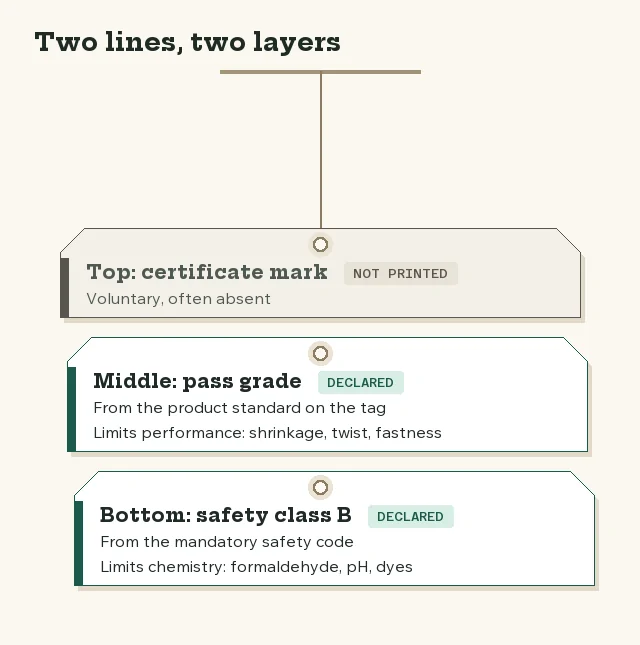
It is easy to read top grade as safer. It is not. The safety class comes from the mandatory safety code and sets limits on chemistry. The grade comes from a recommended product standard and sets limits on performance. They sit on different layers of the tag and answer different questions.
A pass-grade tee can be class B and fully compliant. A top-grade coat can be class C, also compliant. The product standard for tees even says outright that its safety items follow the national safety code, so the grade has no say over formaldehyde or pH.
In the Declaration stack the class sits in the bottom layer and the grade in the middle one, which is the simplest way to keep them apart.
Keeping them apart also changes what you raise with a seller. A missing class is a safety gap worth asking about on any piece worn against the skin; a missing grade is a gap in information that you may simply accept on an inexpensive basic.
The same split shows up in the Declaration stack: a class line fills the bottom layer, a grade and standard number the middle one, and neither can stand in for the other.
When the printed grade and the photo disagree
Appearance is graded piece by piece, which makes it the one part of a grade a photo can test. Holes, broken stitches, misaligned prints, stains and uneven dyeing are appearance flaws, and a top-grade claim on a piece that shows them is a mismatch you can point to.
Internal grades are different. Shrinkage, twist and colorfastness show up only after washing and wearing, so a warehouse photo cannot confirm them either way. If a pass-grade tee twists after its first wash, it may still be inside its band.
When a warehouse photo shows a visible flaw on a piece printed top or first grade, it is worth raising before the parcel ships. CNFans's archived description of its warehouse check mentions defects; the photo is your record of what was found.