
Size notation on a Chinese label: height, girth and the body letter, read without converting
A Chinese size line names the body a garment was cut for. Here is what each figure and letter means, how the series steps, and why this guide never turns it into another system.
Body-type letters after the height and chest figures
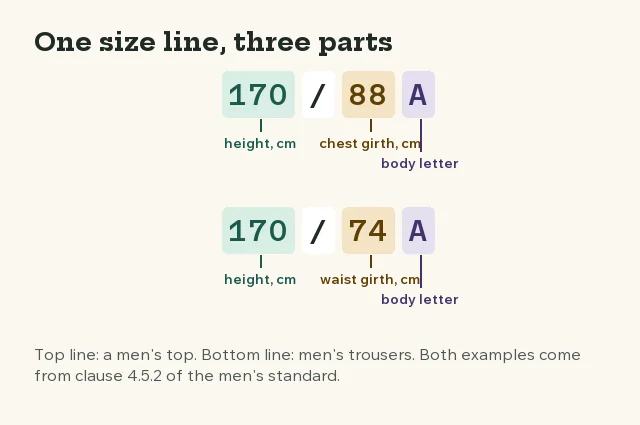
The national size standards for men and women, GB/T 1335.1-2008 and GB/T 1335.2-2008, define the notation printed on Chinese adult labels. The first figure, the 号, is body height in centimeters. The second, the 型, is chest girth for a top or waist girth for a bottom, also in centimeters. A slash separates them and the body letter follows.
The standards give their own examples. For men a top reads 170/88A and a bottom 170/74A. For women a top reads 160/84A and a bottom 160/68A. Tops and bottoms are labeled separately, which is why a suit can carry two sizes.
Every figure describes the wearer the garment was cut for, not the garment. That is the key to reading it correctly.
Men's and women's bands
The letter describes build as the difference between chest and waist girth. For men, Y covers a 17 to 22 centimeter difference, A 12 to 16, B 7 to 11 and C 2 to 6. For women the bands sit higher: Y 19 to 24, A 14 to 18, B 9 to 13 and C 4 to 8.
So Y is the slimmest waist for a given chest and C the fullest. A is also the letter both standards use in their worked examples.
A woman's A and a man's A are not the same body. When a tag gives only a letter and figures, check which standard the garment follows before reading the letter.
Chest minus waist, by letter
| Letter | Men, cm | Women, cm |
|---|---|---|
| Y | 17 to 22 | 19 to 24 |
| A | 12 to 16 | 14 to 18 |
| B | 7 to 11 | 9 to 13 |
| C | 2 to 6 | 4 to 8 |
GB/T 1335.1-2008 and GB/T 1335.2-2008, clause 3.3, read 19 October 2026.
How the size series steps
Sizes move in fixed steps. Height steps by 5 centimeters, chest by 4, and waist by 4 or 2. Pairing height with chest gives what the standards call the 5.4 series; pairing height with waist gives the 5.4 and 5.2 series for bottoms. Each series is built outward from a middle body for each letter.
In practice that means neighboring sizes on a 5.4 rack read 165/84A, 170/88A, 175/92A: five more centimeters of height, four more of chest. A label outside that rhythm, such as an odd chest figure, is either a different series or a maker's own sizing.
Because the steps are fixed, a size line also tells you the neighbors. If 175/92A is tight across the chest, the next chest figure in the same series is 96, whether the label pairs it with 175 or with 180.
A men's A run in the 5.4 series
| Height, cm | Chest, cm | Size line |
|---|---|---|
| 165 | 84 | 165/84A |
| 170 | 88 | 170/88A |
| 175 | 92 | 175/92A |
| 180 | 96 | 180/96A |
Steps from clauses 4.1.2 to 4.1.5 of GB/T 1335.1-2008; 170/88A is the standard's own example.
Children's sizes carry no letter
The children's size standard, GB/T 1335.3-2009, defines only the two figures. There is no body letter, so a baby or child size reads like 73/48 or 66/44 and stops there.
The steps change with age. Infants from 52 to 80 centimeters tall step by 7 centimeters of height, children from 80 to 130 by 10, and older girls up to 155 and boys up to 160 by 5. Chest steps by 4 and waist by 3 throughout.
A letter after a child size is not part of the national notation. It may be a maker's own code; read the figures and ignore the letter.
Children's pieces also bring their own safety code, so a child's tag may cite GB 31701 next to the size. The two lines are independent: the size says how big the child is, the safety line which class the piece claims.
Infant tops, from table 1
| Height, cm | Chest figures, cm |
|---|---|
| 52 | 40 |
| 59 | 40, 44 |
| 66 | 40, 44, 48 |
| 73 | 44, 48 |
| 80 | 48 |
GB/T 1335.3-2009, table 1. No body letter appears anywhere in the children's standard.
Socks, hats, gloves and scarves state other measures
The label-set standard asks each kind of textile to state the measure that suits it. Socks give a sock size or the range they fit; tights give the height and hip range of the wearer. Hats give the circumference of the opening or a range. Gloves give the length and width of the hand.
Bedding, scarves, towels and curtains give their main dimensions, such as length, width or weight. Yarn and fabric give a main specification such as linear density or width. Anything else states whatever size or specification its features call for.
That is why the catalog's sock and hat shelves carry their own note: a beanie with a circumference and no height figure is labeled exactly as the standard asks.
Knit pieces may use another series
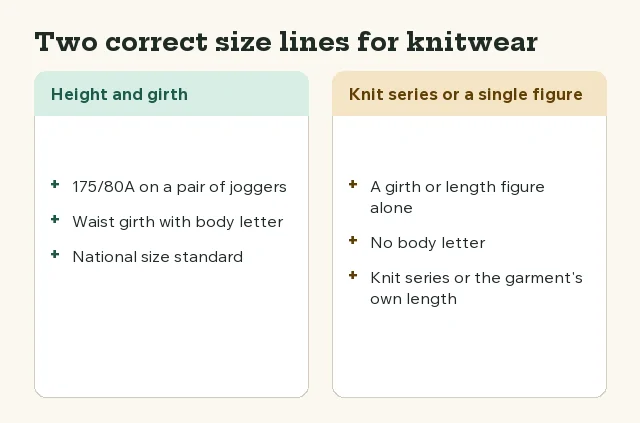
Clause 5.3.4 of the label-set standard says clothing should show its size range the way the national size standard or the knitted underwear size series, GB/T 6411, does it. It then allows knitted clothing to state the garment's length or girth instead.
That opens the door to several correct forms on knitwear and jersey: a height and girth with a letter, a single girth, or a length. The T-shirt standard adds its own route, sending sizes to the industry size series for tees or to the national size standard.
So on sweatpants, leggings and base layers a single figure is not a mistake. It is one of the allowed notations, and the standard line on the same tag tells you which series it follows.
Why this guide stops at reading the size
The size-notation standard discussed here describes body measurements; a seller chart can instead describe a garment, or may be unclear. In the dated 40-listing sample, garment charts were common and the body notation was not legible in the sampled photos. Ask which convention your selected item uses before comparing numbers.
Turning a body size into a letter size or into another country's system needs assumptions about ease and cut that no label states. That is a separate job, and this site does not do it.
What reading the line does give you is a check. If the listing says the piece is for a 175 centimeter wearer with a 92 chest and the sewn label in the warehouse photo says 165/84A, something was swapped, and it is visible before the parcel ships.