
Blank tags and garments sold without one, and what the absence tells a CNFans buyer
A plain white card declares nothing. Here is why that is common in practice, what we found when we looked for labels before purchase, and how to read the gap once the warehouse photo arrives.
Blank tags and garments sold without one
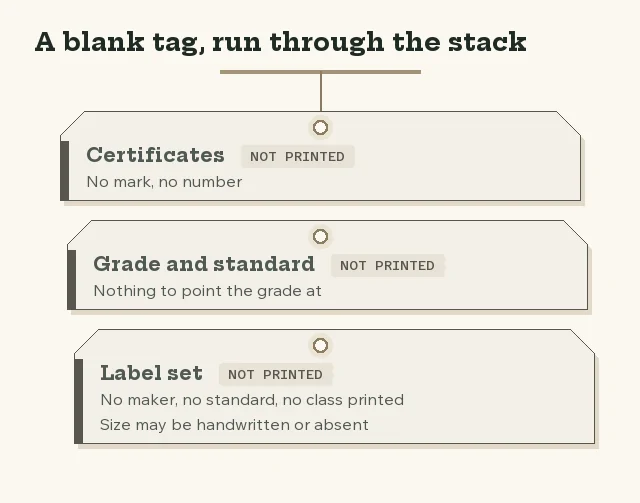
A blank tag is a plain white card, sometimes with a size written or stamped on it and nothing else. Some pieces arrive with no hang tag at all, only a size strip or not even that. Either way the garment carries no declaration: no standard number, no safety class, no grade, no maker.
In practice this is common with wholesale stock and plain basics with no maker name on them, where a seller buys plain pieces in bulk and sells them on, or where labels are added later by whoever puts their own name on the goods. It is not, by itself, a sign of anything wrong with the piece.
What it changes is where your information comes from. With a printed tag the garment speaks for itself. With a blank one, everything you know comes from the listing and the seller's replies, and the warehouse photo can only confirm that nothing is printed.
Our look at forty listings before purchase
To see how much of a label a buyer can read before paying, we opened 40 listings from the catalog shelves on 19 October 2026, without an account, using a phone-sized browser. They came from tees, hoodies, knitwear, jeans, sweatpants, trousers, outerwear and socks. We kept every product and detail image at least 200 pixels wide, 398 in all, and went through them by eye.
No image let us read a Chinese label line with a standard number, a safety class or a grade. Two images showed a tag close-up at all, and both were swing tags printed in English. Size charts measured in centimeters were common; the body notation such as 175/92A did not appear once.
That is one sample on one day, and other listings may well show their tags. It is enough to set an expectation: plan on reading the label from the warehouse photo, or ask the seller first.
The sample, shelf by shelf
| Shelf | Listings | Images | Readable label lines |
|---|---|---|---|
| Tees | 6 | 54 | 0 |
| Hoodies | 6 | 70 | 0 |
| Knitwear | 5 | 35 | 0 |
| Jeans | 5 | 32 | 0 |
| Sweatpants | 5 | 93 | 0 |
| Trousers | 4 | 24 | 0 |
| Outerwear | 5 | 63 | 0 |
| Socks | 4 | 27 | 0 |
Images counted at 200 pixels or wider, a few shop banners and placeholders included. Total 40 listings, 398 images.
Why blank tags turn up so often
Part of the answer is in the rules themselves. The label-set standard became a recommended standard on 23 March 2017, and its serious-fault grading is written for goods sold in Chinese shops. A plain piece passing between traders is not yet at that point, and pieces made for export follow the buyer's contract.
The safety code still binds anything made or sold in China, and the product quality law still asks for a certificate of conformity and a Chinese name and address. Those duties sit with whoever puts the product on the market, which is exactly the step a wholesale listing may be skipping.
So a blank tag usually tells you where the piece sits in the chain, not how it was made. Treat it as missing information, and decide how much that missing information matters for the garment in question.
Asking a seller before you order
The simplest way to judge a seller on labels is to ask. A one-line message asking for a photo of the sewn-in label and the hang tag costs nothing and the reply says a lot: a clear photo, a photo of a different piece, a promise to check, or silence.
Ask for both carriers. The sewn strip carries size, fiber and care; the hang tag carries the standard, class and grade. A seller who sends only one may simply not have the other, which is useful to know before paying rather than after.
Keep the reply. If the warehouse photo later shows a different label, the seller's own photo is the clearest record of what was offered. Good sellers tend to answer this kind of question quickly, because it is easy for them; a vague answer to an easy question is a seller signal in itself.
Reading the absence in a warehouse photo
When the warehouse photo shows a blank tag or none, there is nothing to transcribe, and the Declaration stack will report every layer as not declared. That is a reading, not a failure.
How much it matters depends on the garment. For a baby piece it matters most, because the safety code requires the infant wording on everything for children of 36 months or younger. For underwear and next-to-skin basics it matters more than for a coat. For a hat or a pair of socks the label set asks very little to begin with.
The photo can still confirm the things the listing promised that are visible: the color, the size range if written, the construction. Those become the whole check when the label has nothing to say.
How much a missing label matters
| Garment | Missing label | Why |
|---|---|---|
| Baby clothing | matters most | infant wording is required |
| Underwear, tees | matters | class B floor, skin contact |
| Hoodies, knitwear | matters some | class depends on wear |
| Coats, jackets | matters less | class C floor |
| Hats, socks | little | few label lines expected |
Our reading of the safety code and the label-set standard. It is a priority order, not a legal grading.
When a blank tag is a reason to pause
A few combinations deserve a second look before shipping. A baby piece with no label at all. A listing that sold the piece on a certificate or an organic claim, arriving with no card. A listing that stated a fiber or a size that the photo now contradicts.
None of these proves anything about the maker, and this guide does not try to judge whether a piece is genuine. They are mismatches between what was promised and what arrived, and the warehouse stage is the least costly moment to raise them.
When nothing was promised, a blank tag is just a blank tag. Buy plain basics knowing that the label will not tell you more than the listing did.