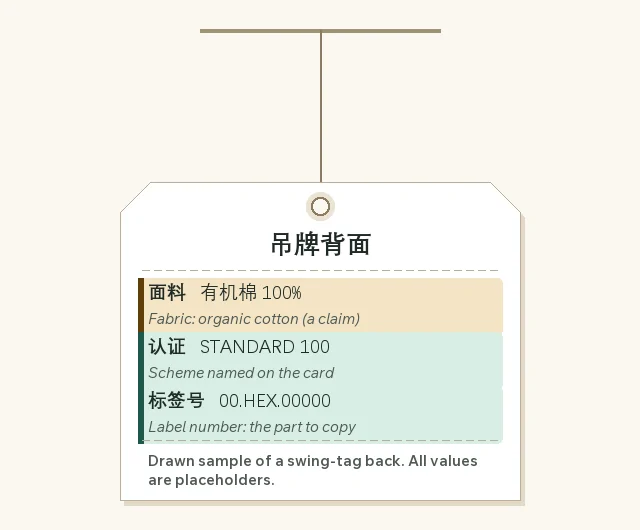
Certificate marks on a swing tag, checked against the registers that issue them
Certificate marks are voluntary, private and checkable. Each scheme keeps a public register, and a mark only becomes more than a claim when its number turns up there.
Certificate marks claimed by sellers, checked against public registers
Above the label set sits an optional layer: marks from private certification schemes. The ones most often printed on swing tags cover harmful substances, recycled content and organic fiber. None of them is required by Chinese law, and none of them replaces the safety class.
Each scheme is run by a standard owner that certifies companies through approved bodies, and each publishes a register. That gives every mark a test: a number or a company name that should resolve in the owner's register, for the right kind of product, and in date.
Until it resolves, this guide reads a mark as a claim. That is not suspicion of any seller. It is simply the difference between a printed logo and a record somebody else keeps.
Three kinds of mark, three registers
| Mark claims | Scheme | Where to check |
|---|---|---|
| Tested for harmful substances | OEKO-TEX STANDARD 100 | Label Check, by label number |
| Recycled content | Global Recycled Standard | Certificate holder list |
| Organic fiber | OCS or GOTS | Holder and supplier lists |
Registers opened on 19 October 2026. All three are public and need no account.
OEKO-TEX labels and the label number
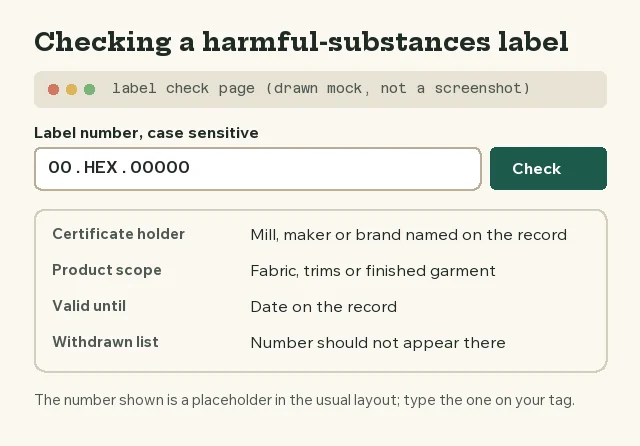
OEKO-TEX describes its STANDARD 100 as a label for textiles tested for harmful substances, with stricter requirements the more intensive the skin contact. Each label carries a label number, and that number is what a check asks for.
The OEKO-TEX Label Check takes that number directly. Its own page warns that label numbers are case sensitive, so copy them exactly, and it keeps a separate list of withdrawn certificates and labels.
A good result shows who holds the certificate and what it covers. If the holder is a fabric mill, the certificate may cover the fabric rather than the finished garment, which is a normal arrangement but a narrower claim than the tag implies.
Recycled content under the Global Recycled Standard
The Global Recycled Standard is owned by Textile Exchange, which also runs the Organic Content Standard. Its list of certificate holders brings together scope certificates supplied by the active certification bodies, so a buyer can confirm whether a named company holds a certificate and for which materials.
Goods moving between certificate holders travel with transaction certificates, which the holders can authenticate through the same owner. A consumer does not see those, but can check the company.
So the useful transcription from a recycled mark is the name or identifier of the certificate holder printed with it. A mark with no company and no number gives the register nothing to find.
Organic claims and the two standards behind them
"Organic cotton" on a tag is the claim most often printed without a scheme. The two schemes that certify it do different jobs. The Organic Content Standard tracks organically grown fiber from the farm through the supply chain, and accepts only material from farms holding organic certification under the international organic family of standards.
GOTS certifies processing as well as fiber content and keeps a supplier database that its certification bodies update. Its own note says the bodies were still moving data into a new repository when we looked, so a missing entry is worth a second look before concluding anything.
Organic words with no scheme named, no company and no number are a description, not a certification. The label-set standard asks that instructions contain nothing exaggerated or false.
What a successful lookup settles
A clean result settles four things: the certificate exists, it belongs to a named company, it covers a stated scope, and it is in date. That is far more than the printed mark alone.
It does not settle that your piece is covered. The scope may be a fabric, a single product line or a different production site, and a tag can carry a mark copied from another product. Matching the company on the record with the maker on the tag is the closest a buyer can get.
The harmful-substances register also answers a question the safety class cannot: whether somebody outside the maker tested the material. That is the real value of the top layer, when it holds.
Words that point to no register
Some tags carry words in place of a mark: eco, green, healthy, natural, or claims such as free of formaldehyde. None of these is a certification, and none can be looked up.
The label-set standard's principles say instructions should introduce a product truthfully and contain nothing exaggerated or false. A formaldehyde-free claim, for instance, goes further than the safety code, which sets a ceiling rather than zero. It is a claim the maker owns, with no register behind it.
Transcribe such words if you like, but in the Declaration stack they belong to no layer. Only a named scheme with a number moves the top layer from not declared to declared.
Marks, words and what stands behind them
| On the tag | Behind it |
|---|---|
| Scheme name with a number | A register entry to look up |
| Scheme name, no number | A company to search, if named |
| "Organic" with no scheme | Nothing checkable |
| "Eco", "green", "healthy" | Nothing checkable |
| "Formaldehyde free" | A maker's claim beyond the code |
Clause 4.3 of GB/T 5296.4-2012: no exaggerated or false content.
Finding a mark in a warehouse photo
Certificate marks are usually small and printed on the back of a swing tag or on a separate card on the same string. In a general warehouse photo the number is often too small to read, so if a find is sold partly on a certificate, a close-up of that card is worth asking for.
CNFans's archived description of its warehouse check speaks of defects, sizes and colors, not of certificates, and neither the agent nor this guide can confirm a mark. The photo's job is to give you the number; the register's job is to answer for it.
Then enter the mark in the Declaration stack. The top layer will tell you which register to use and what the result can and cannot settle.
The back of a tag is also where small print such as an address or a barcode sits, so a close-up of the back is useful even when no mark is printed on it.