
The label set on a Chinese garment, read line by line before CNFans photographs it
Eight lines, two carriers, one law behind the paper tag. This page reads the consumer-label standard for clothing in the order a tag is printed, and marks where it was softened in 2017.
The label set a Chinese garment is expected to carry
The standard that governs instructions on textiles and clothing sold in China, GB/T 5296.4-2012, gives a short list in its fifth chapter. A garment's label set should name the maker and its address, give the product a name, state the size, list the fiber content, show how to care for it, cite the product standard it was made to, state its safety class and, where misuse could damage the piece, add a note on use or storage.
Those eight lines can be spread over several carriers. The standard names six forms: printing or weaving directly on the product, a permanent label fixed to it, a tag hung on it, a tag on the packaging, print on the packaging, and papers supplied with it. When more than one form is used, the content has to agree across them.
In practice the lines usually split the same way. The woven or printed strip at a seam carries size, fiber and care; the paper hang tag carries the rest. Read both, because each one is only half the set.
A maker's name, and why an import prints two
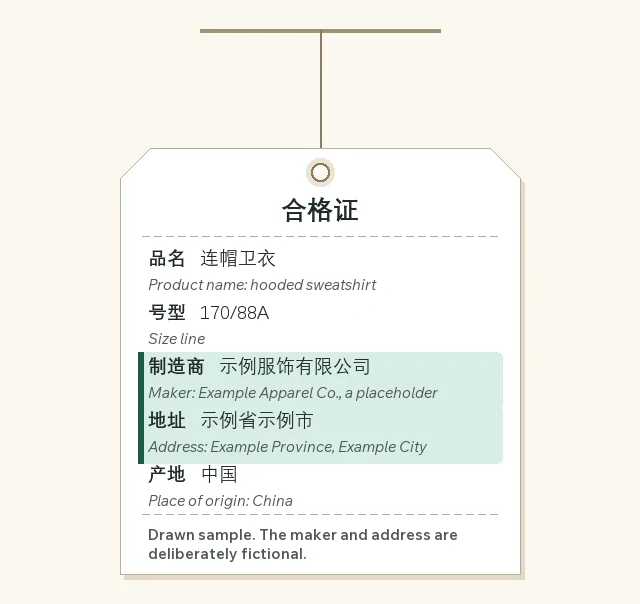
The first line answers a simple question: who stands legally responsible for this piece. The standard asks for the maker's name and address exactly as registered. An imported garment adds its country or region of origin and the registered name and address of the agent, importer or seller in mainland China.
The product quality law asks for the same thing in its own words: a product name, the producer's name and the producer's address, all in Chinese. On a hang tag this usually appears near the bottom, under a heading such as 制造商 (maker) or 生产企业 (producer).
This guide never prints a maker's name from a real tag, and the drawn samples use a placeholder. When you read your own warehouse photo, the useful check is whether a name and address appear at all. A tag with a full set of standards but no responsible party is missing its first and most basic line.
A tag that gives a shop name with no address is missing half of that line, and a name in pinyin only is missing the Chinese the law asks for.
Size, fiber and care belong on a strip that survives washing
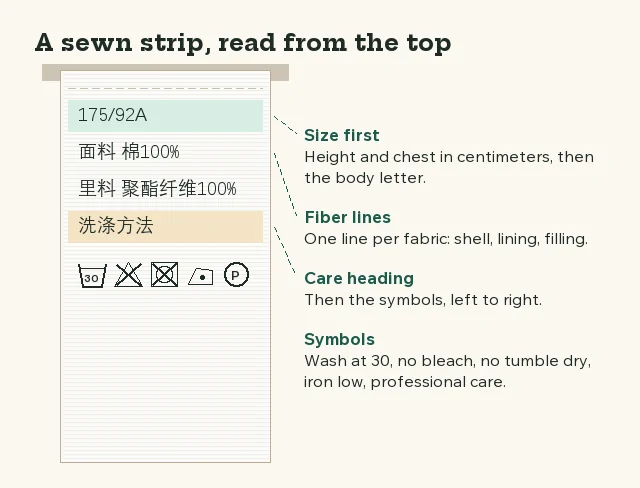
Three of the eight lines are singled out. Clause 6.2.1 says size, fiber content and care method should be on a permanent label, meaning one fixed to the garment for its working life and still legible after washing. The other lines are better carried somewhere else, which is why the paper tag exists.
There are sensible exceptions. Socks, gloves, bolts of fabric and yarn can skip the permanent label when one would get in the way of use, and uniforms made to order for a group and not cared for by one person can skip it too. If packaging or folding hides the permanent label in a shop, the same information has to appear somewhere visible as well.
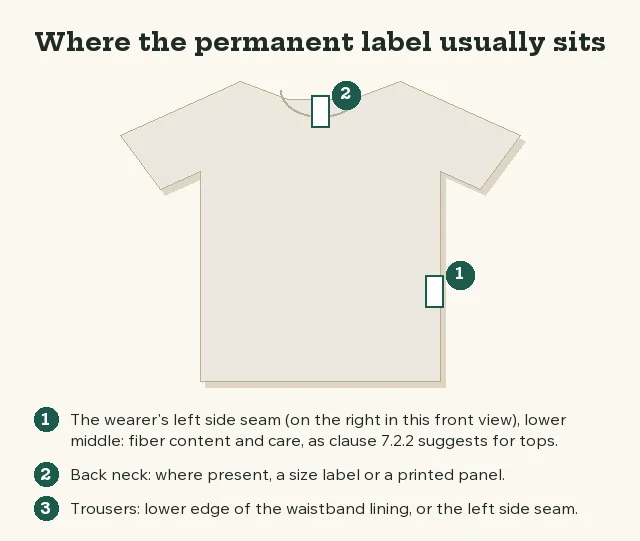
The standard also suggests where to look. For tops the fiber and care label is usually sewn into the left side seam, in its lower middle part. For bottoms it sits at the lower edge of the waistband lining or in the left side seam. A neck label, where there is one, may carry only the size.
Care symbols and the words beside them
Care method has to be given with the graphic symbols of the national care-labeling standard, GB/T 8685, and words may be added next to them. Where the symbols cannot say enough, the maker should explain in words. The usual sequence reads left to right: washing, bleaching, drying, ironing, professional cleaning.
For a buyer abroad the symbols are the most portable part of a Chinese label, because the national system follows the international one. The words beside them are where a maker adds what symbols cannot, such as wash inside out or wash dark colors separately.
Fiber content sits on the same strip and follows its own textile standard. This guide leaves the reading of fibers and fabrics to the product notes and only checks that the line is there: a care strip with no fiber line is missing one of the three permanent items.
Chinese characters first, other scripts no larger
Clause 8.2 asks for standard Chinese characters throughout. Pinyin, minority scripts or foreign languages may appear alongside, but their type should be no larger than the Chinese. A domestic garment whose only text is English is therefore missing its required language, not just a translation.
Garments made for export are a different case. The safety code applies to goods made and sold in China and lets export production follow the buyer's contract, so a piece that was meant for another market may carry that market's label and nothing Chinese at all.
That matters when reading a warehouse photo. An English-only tag is not a defect in itself. It does mean the Chinese label set, and with it the safety class and the standard number, is simply absent, and the garment brings no declaration that this guide can read.
The gaps the standard counts as serious
An informative annex to the label-set standard grades the faults. Every wrong or missing detail counts as a defect, and four kinds count as serious: any one of the first seven items missing, no permanent label where one is required, a permanent label without its size, fiber or care line, and the same item stated differently on two carriers.
Two of these are visible in a single photo. A hang tag with no safety class or no standard number is missing a core item. A size on the hang tag that differs from the size on the sewn strip is an inconsistency, and it is the one that most often explains a fit surprise.
The annex is for products sold in China, and it describes how inspectors grade a label, not what a buyer abroad is owed. It is still a fair yardstick for how complete a label is.
The certificate of conformity comes from law
The hang tag gets its everyday name, 合格证, from the product quality law rather than from a standard. Article 27 of that law requires a product or its packaging to carry a certificate that it passed inspection, a Chinese name with the producer's name and address, and, where the product calls for it, its specification, grade and main ingredients in Chinese.
Article 26 adds the line that gives every standard number its weight: a product must conform to the product standard marked on it or its packaging. Once a maker prints a standard, that standard is what the piece is measured against, whether or not it was mandatory to begin with.
On a tag, the inspection part is often just a word and a number, 检验合格 with an inspector stamp. It records that the maker says it checked the piece. It is not a third-party test.
Where the label set stops applying
The label-set standard covers textiles and clothing sold in China, and its own annex lists what falls outside: disposable items, upholstery fillings, shoes and insoles, decorative paintings and hangings, small craft items, umbrellas, bags, packing cloth, braces and suspenders, diapers, toys, pet goods, cleaning cloths, screens, flags and artificial flowers.
For a catalog shopper the important entries are shoes and bags. A sneaker or a backpack is not expected to carry the eight lines, so finding no standard number on them tells you nothing about the seller. The safety code excludes the same two groups.
The product quality law still applies to them, so a certificate of conformity and a Chinese name and address are expected on goods made for the domestic market. Everything else on this site is about clothing and home textiles.
Outside the label-set standard
| Group | Entries |
|---|---|
| Footwear and carry | shoes and insoles, bags, umbrellas |
| Home | upholstery fillings, screens, decorative hangings |
| Small goods | craft items, artificial flowers, flags, cleaning cloths |
| Other | disposable items, diapers, toys, pet goods, braces |
GB/T 5296.4-2012, annex A (normative), read 19 October 2026.