
Safety classes A, B and C on a Chinese tag, and the limits each letter stands for
The A, B or C line refers to a basic-safety classification under the Chinese textile standard discussed here. It is one part of the label. The printed claim alone does not establish that the garment was tested or complies with every applicable requirement.
Safety classes A, B and C
The national general safety code for textile products, GB 18401-2010, is the one mandatory document behind a Chinese clothing tag. It applies to clothing, decorative and household textiles made and sold in China, and it says plainly that products which miss it may not be made, sold or imported.
It sorts products into three classes by how strict the limits are. Class A is the strictest, class B the middle, class C the most lenient. Which class a product must reach depends on who wears it and how much of it touches the skin, and the maker prints the class it claims, one class per piece.
The code has been in force since 1 August 2011 and was still current on its official record when we read it on 19 October 2026. It replaced a 2003 version, so very old stock may still cite that one.
If you remember one thing from this page, make it the floor for each kind of garment: A for babies, B for anything that lies on the skin, C for outer layers.
The diagram summarises the hierarchy of the cited edition for reading a claim. It does not show a test result for a particular garment. Confirm the applicable product scope and edition before using a class letter to assess a purchase.
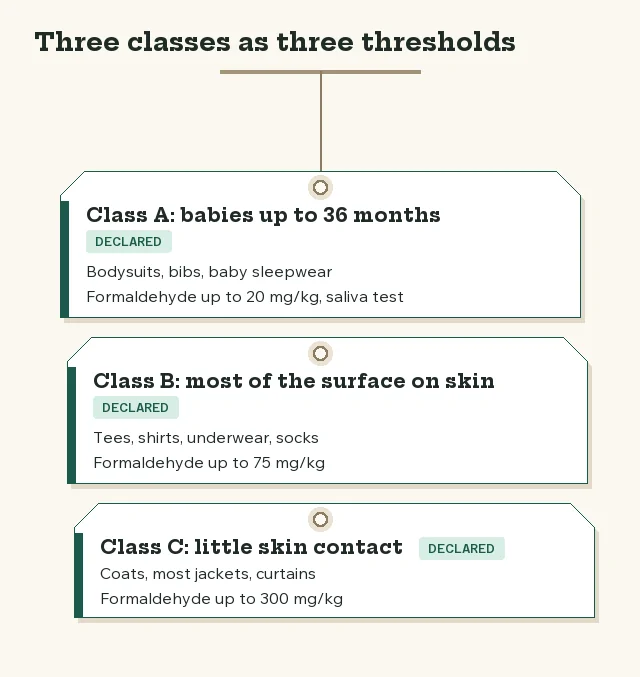
Who each class is written for
The definitions are short. Infant textiles are those worn or used by children of 36 months or younger, and a note adds that pieces generally sized for 100 centimeters of height or less can be treated as infant products. Direct skin contact means most of the piece touches the skin in use. Little skin contact means it does not touch the skin, or touches it only in small areas.
Clause 5.2 then sets the floors: infant products must meet class A, direct-contact products at least class B, and other products at least class C. "At least" matters, because a maker can claim a stricter class than the floor.
Fabric sold by the meter or yarn is classed by what it will become. A fabric meant for shirting is held to the class a shirt would need, even though nobody wears the bolt.
Floor class by wearer
| Wearer and contact | Floor | Printed as |
|---|---|---|
| Babies, 36 months or younger | A | 婴幼儿用品 |
| Most of the surface on skin | B | B类 or better |
| Little or no skin contact | C | C类 or better |
| Fabric or yarn | by end use | class of the end product |
GB 18401-2010, clauses 3.3 to 3.5, 4.2, 5.2 and 5.3.
The limits behind the letters
Table 1 of the code turns each letter into numbers. Free and hydrolyzed formaldehyde may not exceed 20 mg/kg for class A, 75 for class B and 300 for class C. The pH of the fabric must fall between 4.0 and 7.5 for A, 4.0 and 8.5 for B, and 4.0 and 9.0 for C. Odor must be absent in every class, and azo dyes that can break down into listed carcinogenic amines are banned in every class, with a limit of 20 mg/kg.
Colorfastness gets five lines: to water, to acid sweat, to alkaline sweat, to dry rubbing and to saliva. Class A needs grade 3-4 for the first three and grade 4 for dry rubbing and saliva. Classes B and C need grade 3 and skip saliva, which is tested only on infant products.
The footnotes carve out sensible cases: undyed and bleached goods, and hand-dyed crafts such as tie-dye and batik, are excused from the colorfastness lines.
Table 1, written out
| Item | A | B | C |
|---|---|---|---|
| Formaldehyde, mg/kg max | 20 | 75 | 300 |
| pH | 4.0-7.5 | 4.0-8.5 | 4.0-9.0 |
| Fastness: water, sweat | 3-4 | 3 | 3 |
| Fastness: dry rubbing | 4 | 3 | 3 |
| Fastness: saliva | 4 | n/a | n/a |
| Odor | none | none | none |
| Banned amine dyes | banned | banned | banned |
Colorfastness in grades on a 1 to 5 scale, higher is better. Amine dye limit 20 mg/kg.
Baby clothing prints words instead of a letter
Clause 5.3 gives infant products their own marking. Instead of a letter, the instructions must carry the words 婴幼儿用品, infant product. Every other product names the class it meets, for example class A, class B or class C, and each piece carries one class only.
Children's clothing has a second mandatory code, GB 31701-2015, in force since 1 June 2016. It asks infant products to print its own number with the infant wording, and children's products, for ages over 3 and up to 14, to print its number with a class, such as GB 31701 B. A piece marked that way does not need a separate class line under the general code.
So a kids' hoodie can legitimately show either code. The one combination worth questioning is a baby piece, sized 100 centimeters or under, that prints class B or C.
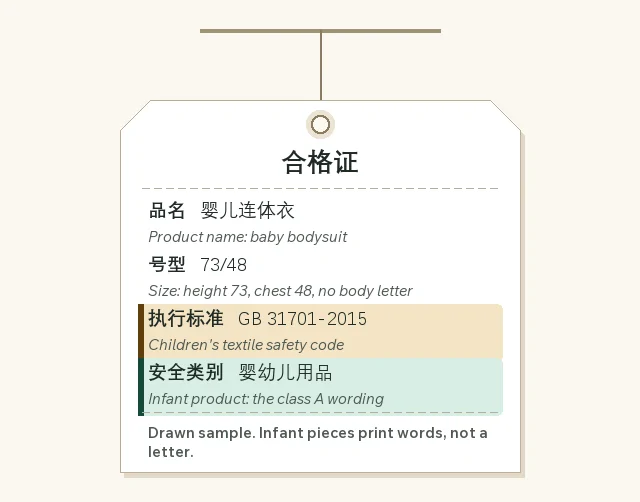
Children's pieces answer to extra rules
The children's code keeps the same three classes and adds requirements of its own. For the strictest class it sets limits on lead and cadmium in coated or pigment-printed fabric, and limits certain phthalates in coatings and prints. Classes A and B also need a wet-rubbing colorfastness grade, and outer fabrics have a burning behavior requirement.
The part a photo can actually show is construction. Clothing for infants and children under 7 may have no cords or drawstrings at the head and neck. On infant pieces, attachments must resist a set pulling force by size, and on any piece for children no accessible point or edge may be sharp.
None of this is visible as a printed line. It is listed here so that a children's tag citing the code is read as the larger promise it is, and so that a drawstring hood on a toddler jacket stands out in the warehouse photo.
What a class letter cannot tell you
A printed class is the maker's claim that the product meets that class in table 1. Compliance is policed by sampling: the code says the state supervises textiles mainly through spot checks under the product quality law. Nobody tests the piece in your parcel, and neither this guide nor the warehouse can.
Some limits do not reach every part. Small components weighing no more than 1 percent of the whole piece are not assessed for direct-contact and outer products, so a tiny trim does not have to meet the body fabric's class.
What a reader can check is consistency. A tee or underwear printed with class C is claiming less than its floor. A coat printed with class A is claiming more than it needs, which is allowed. A baby piece with a letter instead of the infant wording is marked wrong. Each of these is readable without a lab.
Finding the class line in a warehouse photo
On a hang tag the class line usually starts with 安全类别 or 安全技术类别, safety category, and continues with the code number and a letter, such as GB 18401-2010 B followed by the character for class. Some tags shorten it to the letter alone; the code's own example is simply class A, class B or class C.
Look for it under the standard-number line. If the photo is angled, the letter is the part most often lost to glare, so it is reasonable to ask CNFans for a straight shot of the tag. Whether label close-ups are part of its usual set was not stated on the archived pages we could read.
When you have the letter, put it into the Declaration stack on the home page together with the garment type you ordered, and see whether it reaches the floor.